Watchmen Review: Does the Benchmark Still Hold Up?
A full review of Watchmen — the murder mystery that took apart the superhero, and whether the medium's most acclaimed book still earns the hype.
 By Web Admin
Every “greatest comics of all time” list opens with the same book, and it’s not close. Watchmen, written by Alan Moore and drawn by Dave Gibbons, was published by DC Comics as a twelve-issue series across 1986–1987 and has never been out of print since. It’s the only comic to appear on Time magazine’s list of the best English-language novels, and it more or less invented the idea that superhero comics could be serious literature. But acclaim is a heavy thing to carry for forty years. This review asks the honest question: does Watchmen still hold up for a reader picking it up today?
What is Watchmen about?
Set in an alternate 1985 where costumed vigilantes are real and the United States won the Vietnam War, Watchmen opens with the murder of a government-sanctioned “hero” called The Comedian. The paranoid Rorschach begins investigating, pulling in a cast of retired and active masks. The murder mystery is the hook. The real subject is power — who gets it, what it does to them, and what it would actually take to save the world.
The characters
Part of what makes the book endure is how fully realised its cast is. Rorschach is an uncompromising, deeply damaged vigilante whose journal narrates much of the book. Dr. Manhattan is the story’s only true superhuman, and his growing detachment from humanity drives its biggest questions. Adrian Veidt (Ozymandias) is “the smartest man in the world.” Dan Dreiberg (Nite Owl) and Laurie Juspeczyk (Silk Spectre) are two people trying to figure out who they are without the costumes. None are simple heroes or villains, and that ambiguity is the point.
Why it still matters
Most “dark” or “deconstructed” superhero stories are just cynical. Watchmen is something rarer and harder: it takes the premise completely seriously. It asks what kind of person puts on a mask, what a genuine superhuman would do to geopolitics, and whether the ends can ever justify the means. Those questions have not aged a day. If anything, its portrait of surveillance, media saturation, and the temptation of authoritarian “solutions” reads as more relevant now than in 1986.
The craft: the nine-panel grid
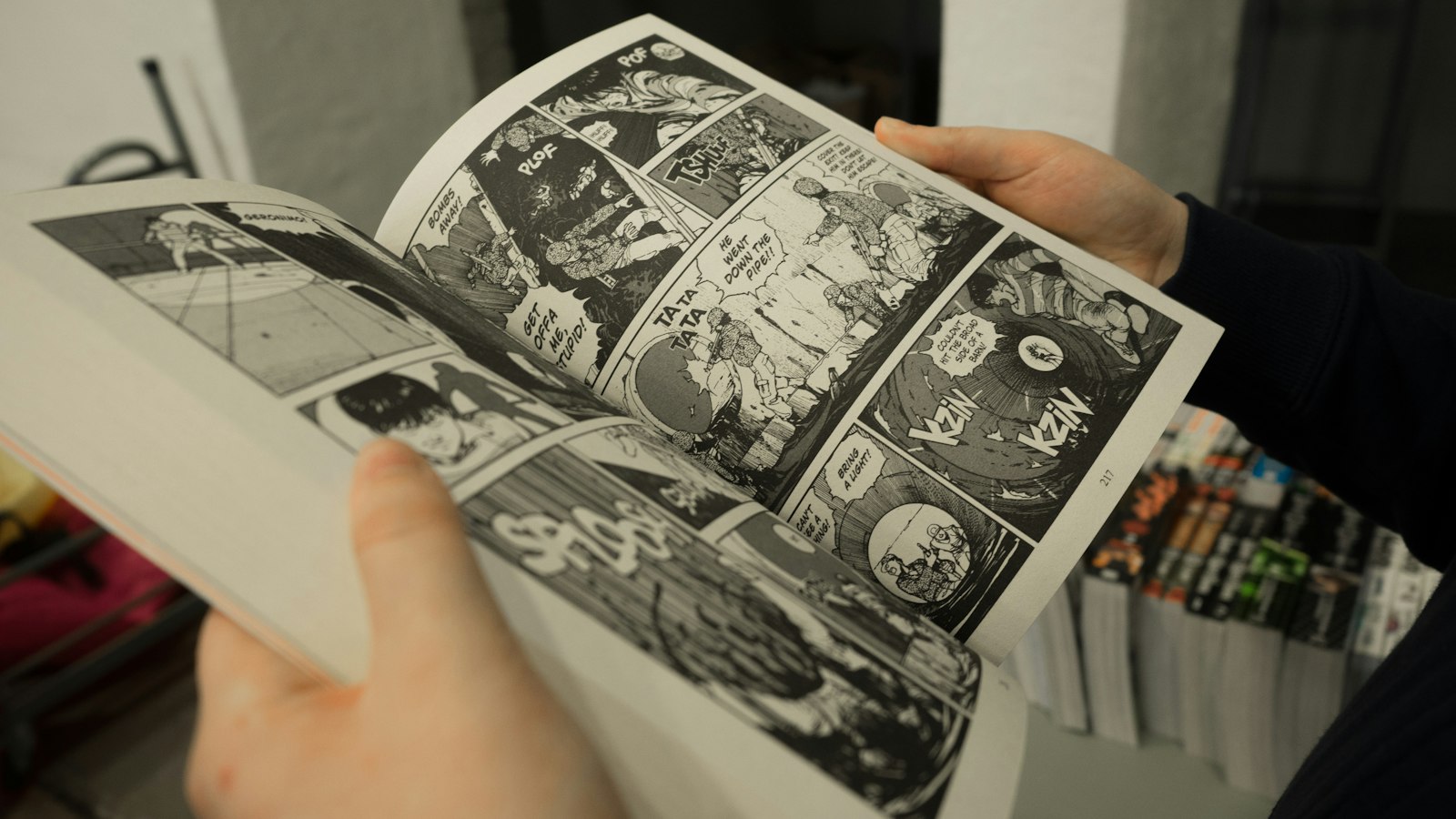
Gibbons built almost the entire book on a rigid nine-panel grid, and Moore’s scripts exploit it relentlessly — mirrored layouts, symbolic repetition, and a famous chapter (“Fearful Symmetry”) that is structured to be nearly identical read forwards and backwards. Recurring motifs (the smiley-face badge, the doomsday clock, a bloodstain) turn the whole book into a machine of visual rhymes. This is comics doing something prose and film simply cannot. It rewards slow, careful reading, and it rewards re-reading even more.
Fair warning: it’s dense
Set expectations. Watchmen is roughly 416 pages, and each of the twelve chapters ends with several pages of “in-world” text — excerpts from a memoir, a pirate comic-within-the-comic, files, and interviews. These aren’t optional filler; they deepen the story, but they slow you down. This is not a breezy weekend read. Give it the attention it asks for and it pays out enormously; skim it and you’ll wonder what the fuss is about.
Pros and cons
Pros
- A complete, self-contained masterpiece — no sequels required
- Formally brilliant; rewards re-reading like little else
- Themes have only grown more relevant
- Historically the most important superhero comic ever made
Cons
- Dense; the text pieces demand patience
- Deliberately bleak in tone
- Not a good “first ever” comic for a nervous beginner
Which edition should you buy?
There are several ways to read it, and the differences matter.
| Edition | Format | Approx. price | Best for |
|---|---|---|---|
| Standard trade paperback | Softcover | ~US$20 | Most readers |
| International / hardcover edition | Hardcover | ~US$30 | A durable shelf copy |
| Absolute Watchmen | Oversized slipcased HC | ~US$75–100 | Appreciating Gibbons’ art |
For a first read, the standard paperback is perfect. If you fall in love with it, the oversized Absolute Edition is one of the best-looking books on any comics shelf.
AmazonCheck price on AmazonLegacy and adaptations
Watchmen reshaped the entire industry alongside The Dark Knight Returns and Maus, ushering in comics’ so-called “grim and gritty” era (for better and worse). Zack Snyder’s 2009 film adapts the plot fairly faithfully; HBO’s 2019 series is a stealth sequel that genuinely rewards having read the book first. Both are worth your time — after the comic.
Should you read it before a first comic?
Honestly? Maybe not. If you’ve never read a comic in your life, we’d start you gentler — see our Saga review or our best comics for beginners guide — and work up to Watchmen once you’re comfortable reading sequential art. But make no mistake: this is a destination, not a detour. Every serious reader gets here eventually. It also pairs naturally with Frank Miller’s The Dark Knight Returns, its 1986 sibling.
The verdict
Forty years on, Watchmen still holds up — not as a nostalgia object, but as a living, demanding, endlessly re-readable book. It sits at or near the top of our best graphic novels list for a reason. Come to it with patience and it remains the high-water mark for what the medium can do.
Frequently asked questions
Do I need to read Watchmen before the TV show or movie?
The book stands entirely on its own and predates both adaptations. The 2019 HBO series is a sequel of sorts, so reading the comic first genuinely enriches it.
Is Watchmen a standalone story?
Yes. Moore and Gibbons designed it as a complete twelve-issue story with a definitive ending. The various prequels and sequels were made by other creators.
Why is Watchmen considered so important?
It proved superhero comics could be literature, pioneered formal techniques still copied today, and reshaped the entire industry’s ambitions in the late 1980s alongside The Dark Knight Returns and Maus.
Is it hard to read?
Moderately. The story is clear, but the dense layouts and between-chapter text reward slow, attentive reading rather than skimming.
Next, see how it ranks among the greats in our best graphic novels guide, or start a cape journey with our Batman reading order.