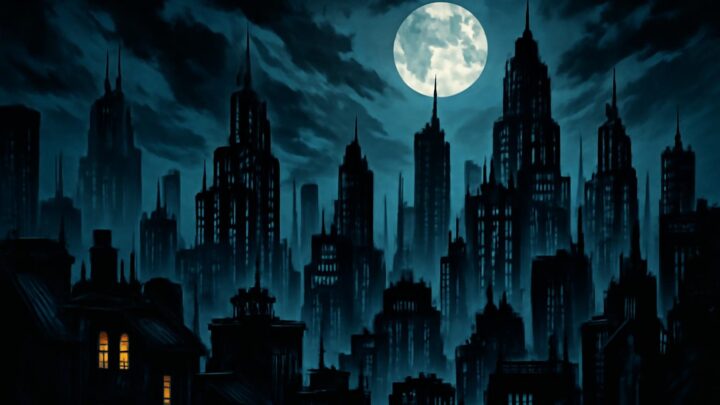
The Dark Knight Returns Review: Batman’s Definitive Epic
Frank Miller's 1986 classic that redefined Batman for a generation.
 By Web Admin

Ask why modern Batman is grim, brooding, and taken seriously, and the answer traces back to one book. Frank Miller’s The Dark Knight Returns, published by DC Comics as a four-issue prestige series in 1986, imagined a 55-year-old Bruce Wayne dragged out of retirement into a broken Gotham — and in doing so it reset the character’s default gravity for the next forty years. Alongside Watchmen and Maus, it’s one of the three books that made comics grow up in the mid-1980s. This is our full review, including the honest question of whether it still hits in 2026.
What is The Dark Knight Returns?
The Dark Knight Returns is a four-issue prestige-format series written and drawn by Frank Miller, inked by Klaus Janson, and colored by Lynn Varley. It’s set in a dystopian near-future where Bruce Wayne, now 55, hung up the cape a decade earlier after the death of Jason Todd. Gotham has rotted in his absence — a violent gang called the Mutants terrorizes the city — and an aging, restless Bruce feels the Bat clawing its way back out of him. The collected edition runs about 224 pages and retails for roughly US$20 in paperback, with deluxe and Absolute editions available for more.
This is not the young, agile Batman. Miller’s Bruce is a battered old warrior who wins through sheer will, ruthless planning, and a refusal to stay down. The book asks what it means for a man to be defined by an obsession he can never outgrow — and whether that makes him a hero or a symptom of a sick society.
The story: four brutal acts
The narrative moves in four escalating chapters. Bruce returns and takes on the Mutant gang, culminating in a savage one-on-one brawl. A new Robin appears — Carrie Kelley, a teenage girl, one of Miller’s best inventions. The Joker, catatonic for years, wakes up specifically because Batman is back, leading to a genuinely disturbing final confrontation between the two. And in the now-legendary climax, a government-controlled Superman is sent to bring Batman to heel, setting up the hero-versus-hero fight that every later “Batman vs. Superman” story is chasing.
Threaded through it all is a savage media satire: the story is narrated in part through TV news anchors, talking-head pundits, and man-on-the-street interviews arguing about whether Batman is a menace. In 1986 this was sharp; today, in an age of 24-hour outrage cycles, it reads as eerily prophetic.
Carrie Kelley and the supporting cast
- Bruce Wayne / Batman — older, harder, and more openly obsessive than any prior version.
- Carrie Kelley — the first female Robin, a 13-year-old whose fearlessness reignites Bruce’s sense of purpose.
- Commissioner Gordon — on the verge of retirement, one of the book’s few voices of weary humanity.
- The Joker — reframed here as a creature who literally cannot exist without Batman.
- Superman — recast as a compromised government agent, a foil for Batman’s defiance.
The art: ferocious, blocky, unmistakable
Miller’s artwork, with Klaus Janson’s heavy inks and Lynn Varley’s muted, painterly colors, is one of the most influential visual packages in comics. It’s blocky, kinetic, and deliberately ugly in places — all mass and motion rather than elegance. The page layouts are restless, cramming rows of small panels against sudden full-page splashes. It won’t be to everyone’s taste; readers raised on cleaner modern art sometimes find it jarring. But it’s inseparable from the book’s aggressive energy, and it defined a whole era of comic art that followed.
The honest caveat: it’s dense and it’s political
Set expectations. This is not a breezy read. Miller packs the pages with tiny TV-broadcast panels, overlapping dialogue, and stream-of-consciousness narration, so it demands close attention. The satire is broad and cynical — Ronald Reagan appears as a folksy dupe, the media is uniformly craven — and the politics are pointedly right-leaning in a way some modern readers find off-putting. It’s also violent, and its worldview is bleak. Miller’s later Batman work (The Dark Knight Strikes Again, All-Star Batman) leaned into self-parody, which has retroactively colored some readers’ view of this one. Judged on its own 1986 terms, though, it remains a powerhouse.
Pros and cons
Pros
- Redefined Batman and influenced every version since
- Genuinely ambitious storytelling and media satire
- Carrie Kelley is a great, fresh addition to the mythos
- The Batman-Superman climax set a template still copied today
Cons
- Dense, cramped layouts demand patience
- Heavy-handed, cynical politics won’t land for everyone
- Miller’s blocky art is divisive
- Bleak, violent tone throughout
How it compares to other essential Batman books
If you’re building a Batman shelf, here’s where The Dark Knight Returns sits relative to the other most-recommended graphic novels.
| Book | Creators | Year | Best for |
|---|---|---|---|
| The Dark Knight Returns | Frank Miller | 1986 | Ambition & influence |
| Batman: Year One | Miller & Mazzucchelli | 1987 | The perfect beginner pick |
| Batman: The Long Halloween | Loeb & Sale | 1996–97 | Noir mystery fans |
| The Killing Joke | Moore & Bolland | 1988 | A dark Joker one-shot |
For the full ranked rundown, see our guide to the best Batman graphic novels, and if you want to read the character’s stories in order, start with our Batman reading order.
Which edition should you buy?
The standard trade paperback (about US$20) is all most readers need and reproduces the art well. If you fall for it, the oversized Absolute Dark Knight hardcover pairs it with its sequel and restores Varley’s colors on premium paper — a beautiful, pricey object at US$100 or so. There’s also a 30th-anniversary edition with extras. For a first read, grab the paperback; upgrade later if it earns a permanent shelf spot.
AmazonCheck price on AmazonIs it a good first Batman comic?
Not quite. It’s a landmark, but its density, dystopian setting, and reliance on you already caring about Batman make it a better second or third read. For a true starting point, we point beginners to Batman: Year One — also by Miller, but leaner and more accessible. Once you know Batman, The Dark Knight Returns becomes essential. Explore both routes through our DC hub and our best comics for beginners guide.
The verdict
Forty years on, The Dark Knight Returns is still one of the most important superhero comics ever made — a fierce, ambitious, imperfect book that permanently reshaped its character and its medium. Its politics grate and its art divides, but its influence is undeniable and its best moments still crackle. Read it knowing what it is: not a gentle introduction, but a genuine landmark that alongside our top-rated Watchmen proved comics could be for adults. Essential, with an asterisk.
Frequently asked questions
Do I need to read other Batman comics first?
It helps. The book assumes you know Batman, the Joker, and the death of a Robin. If it’s your very first Batman comic, consider starting with Batman: Year One or following our Batman reading order first.
Is The Dark Knight Returns connected to the movies?
It heavily inspired the tone of Christopher Nolan’s films and the plot of Batman v Superman, and it was adapted into a two-part animated film. But it’s a standalone comic, not tied to any movie continuity.
Is it appropriate for kids?
No. It’s a mature-readers book with graphic violence, disturbing content, and heavy political satire. It’s written for adults, not children.
What’s the difference between this and The Dark Knight Strikes Again?
The Dark Knight Strikes Again (2001) is Miller’s polarizing sequel, with a very different, cartoonish style and a much more divisive reputation. The original 1986 book is the classic; approach the sequel separately.
Keep building your shelf with the best Batman graphic novels, or dive deeper into the publisher via our DC hub.