Transmetropolitan Review: Warren Ellis’s Gonzo Epic
Warren Ellis and Darick Robertson's furious, prophetic gonzo-journalism epic.
 By Web Admin

Some comics age. A rare few keep getting more accurate. Transmetropolitan belongs firmly in the second group. Written by Warren Ellis and drawn by Darick Robertson, this sixty-issue science-fiction epic ran from 1997 to 2002 — first under DC’s Helix imprint, then under Vertigo — and it reads today less like a period piece and more like a warning we didn’t heed. It follows Spider Jerusalem, a burned-out gonzo journalist dragged back to a filthy, dazzling future megacity to do the one thing he’s good at: tell the truth and make powerful people miserable. This is our full review of what remains one of the sharpest, angriest, funniest comics ever published.

Warren Ellis and Darick Robertson's furious future-shock masterpiece. Profane, hilarious, and startlingly prophetic.…
Check price on Amazon$25.44as of Nov 13, 2026 11:27 pm UTCOur verdict (4.7/5): Warren Ellis and Darick Robertson's furious future-shock masterpiece. Profane, hilarious, and startlingly prophetic. Complete in sixty issues across ten volumes.
What is Transmetropolitan?
Transmetropolitan is a complete, creator-driven series written by Warren Ellis (The Authority, Planetary) and illustrated by Darick Robertson (The Boys). Across sixty issues — roughly 1,500 pages collected in ten trade paperbacks — it tells one long, escalating story. Spider Jerusalem, a notorious journalist who fled the unnamed City years ago to live feral on a mountain, is contractually forced back to civilization to resume writing his column. What starts as a reluctant paycheck becomes a crusade against political corruption at the highest level.
The tone is set immediately: this is a book narrated by a chain-smoking, drug-addled, bald misanthrope who genuinely loves the truth and genuinely hates almost everyone. If the name Hunter S. Thompson comes to mind, that's the point. Spider is gonzo journalism transplanted into a hyper-saturated future — Fear and Loathing with cybernetics.
Spider Jerusalem: gonzo journalism in the future
Spider is one of the great comic protagonists precisely because he is not a nice man. He's abusive to his assistants, reckless with his body, addicted to nicotine and worse, and armed with a "bowel disruptor" that he uses on people who annoy him. But underneath the bile is a genuine, almost holy commitment to the public's right to know. Ellis understood that a truth-teller doesn't have to be likeable to be right, and Spider spends sixty issues proving that decency and cruelty can live in the same skull.
Robertson designs him unforgettably: bald, tattooed, wearing mismatched glasses (one lens round, one square) that became an icon of 1990s comics. He looks like nobody else, which matters in a genre full of interchangeable square jaws.
The City: worldbuilding as sensory overload
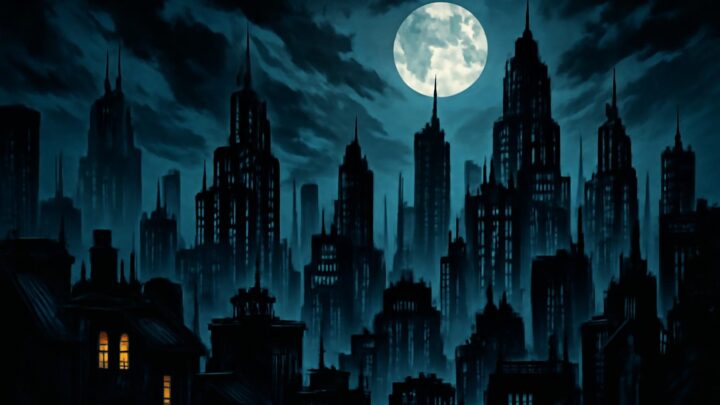
The unnamed City is the book's second great character. It is a future of relentless, gleeful excess — vending machines that dispense narcotics, "make-a-baby" booths, people who upload themselves into clouds of nanomachines, aliens living in the slums, and a religion convention with thousands of splinter faiths under one roof. Robertson and colorist Nathan Eyring pack every panel with background gags, advertisements, and grotesque detail. You can re-read pages just to catch the signage.
Crucially, the City isn't just spectacle. Ellis uses its abundance to sharpen the story's real subject: in a world of infinite information and technology, the poor still get ground under, the powerful still lie, and attention is the only currency that changes anything.
The story: two presidents and one journalist
The spine of the series is political. Spider's reporting first helps take down a sitting president nicknamed "The Beast," only for Spider to realize the man who replaces him — a slick, media-savvy senator Spider dubs "The Smiler" — is far worse. The back half of the series becomes a genuine thriller as Spider and his two assistants, Channon Yarrow and Yelena Rossini, race to expose a president who is willing to murder his own citizens to hold power. Ellis paces the escalation beautifully; the stakes get personal, bloody, and desperate.
Why it feels prophetic in 2026
Written in the late 1990s, Transmetropolitan anticipated an astonishing amount of the present: manufactured outrage, politicians who weaponize likeability, disinformation as a governing strategy, surveillance normalized into wallpaper, and the collapse of the line between news and entertainment. Ellis wasn't predicting specific technology so much as diagnosing power, and that diagnosis has only gotten more relevant. It's a book about media literacy that happens to have jetpacks.
The art: Darick Robertson's density
Robertson's line work carries the whole enormous world. His character acting is expressive and cartoony enough to sell the comedy, but he can flip to genuine horror — riot scenes, a murdered child, the aftermath of state violence — without missing a beat. The sheer information density of his cityscapes is the reason the physical books reward slow reading. This is not minimalist art; it's maximalist, and gloriously so.
Content warning: this is a savage book
Be warned. Transmetropolitan is emphatically for adults. It contains constant profanity, graphic violence, drug use, nudity, sexual content, and unflinching depictions of political brutality and abuse. Spider himself is a deliberately abrasive narrator. The savagery is the point — it's satire with teeth — but this is not a gentle read, and it's not for younger teens. Readers looking for something gentler should browse our best sci-fi graphic novels guide first.
Pros and cons
Pros
- A complete, self-contained sixty-issue story with a real ending
- One of comics' most memorable protagonists
- Prophetic, furious media satire that keeps getting more relevant
- Dense, endlessly re-readable artwork
Cons
- Relentlessly profane and violent — very adult
- The early "issue of the week" arcs are looser than the finale
- Spider's abrasiveness can wear on some readers
How it compares to Ellis's other work and its peers
Within Warren Ellis's bibliography, Transmetropolitan is his most sustained single statement — where Planetary is a puzzle box and The Authority is superhero spectacle, Transmet is a novel. Among Vertigo's giants it sits alongside Preacher and Y: The Last Man as one of the imprint's definitive completed epics. Where it stands apart is subject: this is science fiction about the profession of journalism, a genre almost no one else attempts. If Alan Moore's V for Vendetta is about resisting an authoritarian future through symbols and shadows, Transmet is about resisting it out loud, in print, with your name on the byline.
Which edition should you buy?
The series has been collected several ways over the years. Here's how the main formats compare.
| Edition | Collects | Best for |
|---|---|---|
| Vol. 1: Back on the Street | Issues #1–6 | Trying it out |
| Ten-volume trade run | Issues #1–60 | Reading at your own pace |
| Book One to Book Four | Roughly fifteen issues each | Fewer, fatter books |
For most readers, the collected "Book" editions are the sweet spot — fewer volumes to track and more story per book.
Get Transmetropolitan Book One on Amazon
Is it a good starting point?
It depends on your tolerance. If you already read adult comics and love biting satire, you can dive straight in. If you're brand new to the medium, we'd ease you in gentler first — see our best Vertigo comics guide for the full imprint, or explore the whole Indie hub before committing to sixty issues of Spider Jerusalem.
The verdict
Transmetropolitan is a landmark: a complete, furious, funny, prophetic epic that treats journalism as heroism and readers as adults. It sits high on our list of the best sci-fi graphic novels and remains one of the essential Vertigo runs. If you can stomach its ferocity, few comics will reward you more.
Frequently asked questions
Is Transmetropolitan finished?
Yes. It's a complete, self-contained story that ran for exactly sixty issues from 1997 to 2002, with a definitive beginning, middle, and end. There's no ongoing continuity to keep up with.
Do I need to like science fiction to enjoy it?
Not really. The future setting is vivid, but the book is fundamentally about journalism, politics, and truth. If you like sharp political satire, it works even if hard sci-fi isn't your usual thing.
Is Spider Jerusalem based on Hunter S. Thompson?
He's heavily inspired by Thompson's gonzo persona — the drugs, the fury, the first-person crusading journalism — but transplanted into a science-fiction future and made entirely his own by Ellis and Robertson.
How adult is Transmetropolitan?
Very. Expect constant profanity, graphic violence, drug use, nudity, and sexual content, plus dark political themes. It's strictly for mature readers.
Next, browse the rest of the imprint in our best Vertigo comics guide, or explore more creator-owned work in the Indie hub.
Where should I start reading Transmetropolitan?
Start Transmetropolitan with volume 1, Back on the Street, which collects the opening issues and introduces Spider Jerusalem, his return to the City and his war on the powerful. The series is one continuous story, so reading in order matters. If the first volume grabs you, the rest only gets sharper, and the run builds to a complete, satisfying ending.
Is Transmetropolitan worth reading?
Transmetropolitan is worth reading for anyone who likes sharp political satire, angry humour and dense science-fiction worldbuilding. Warren Ellis and Darick Robertson's sixty-issue series is complete, with a strong ending, and its take on media and politics feels more relevant every year. Be ready for constant profanity, violence and crude jokes; if that does not put you off, it is one of the great comics of its era.
Who are Spider Jerusalem's filthy assistants?
Spider Jerusalem's filthy assistants are Channon Yarrow and Yelena Rossini, the two women who work with him throughout Transmetropolitan. Channon is a former stripper turned bodyguard, and Yelena is assigned to keep an eye on him for his editor. Both become fully developed characters in their own right, and their loyalty and frustration with Spider give the series much of its warmth and humour.
What should I read after Transmetropolitan?
After Transmetropolitan, try The Boys, which reunites artist Darick Robertson with another savage satire, this time of superheroes and corporate power; read our The Boys review. For more Warren Ellis, Planetary and The Authority show his more cinematic side. Readers who loved the political edge may also enjoy Ex Machina, which follows a superhero turned mayor.