Slam Dunk Review: The Greatest Sports Manga?
Takehiko Inoue's funny, thrilling, all-time basketball manga.
 By Web Admin
Ask manga readers to name the greatest sports manga ever made and one title comes up more than any other: Slam Dunk. Created by Takehiko Inoue and serialized in Weekly Shonen Jump from 1990, it ran to 31 complete volumes and helped popularize basketball in Japan almost single-handedly. Decades later it is still the benchmark, and the 2022 animated film The First Slam Dunk introduced it to a whole new generation.
This is our full review of Slam Dunk — the story, why it works, how it compares to other sports manga, and where to buy the complete run.
What is Slam Dunk?
Slam Dunk follows Hanamichi Sakuragi, a red-haired delinquent who joins his high school basketball team for the worst possible reason — to impress a girl, Haruko, who happens to love the sport. He has no skills, a monstrous ego, and no idea what he is doing. Over 31 volumes, Inoue turns that gag premise into one of the most exciting and emotionally rich sports stories ever told, as Sakuragi and the Shohoku High team fight their way toward the national championship.
If you know Inoue only from the painterly samurai epic Vagabond, Slam Dunk shows the other side of his talent: comedic timing, kinetic action, and a completed story with a real ending.
The story: a delinquent learns to love the game
What makes Slam Dunk special is that it earns every beat. Sakuragi begins as a joke — a loudmouth who only cares about a crush — but Inoue slowly, believably transforms him into someone who genuinely loves basketball. The comedy never disappears, but it sits alongside real growth, rivalry, and heartbreak. By the legendary final arc, the laughs and the tension coexist perfectly.
The games themselves are the draw. Inoue choreographs matches with astonishing clarity, and he understands that a great sports story is about momentum — the swing of a game, the exhaustion, the single play that changes everything. The climactic Sannoh match in particular is regularly cited as one of the finest sequences in manga history.
The art: motion on the page
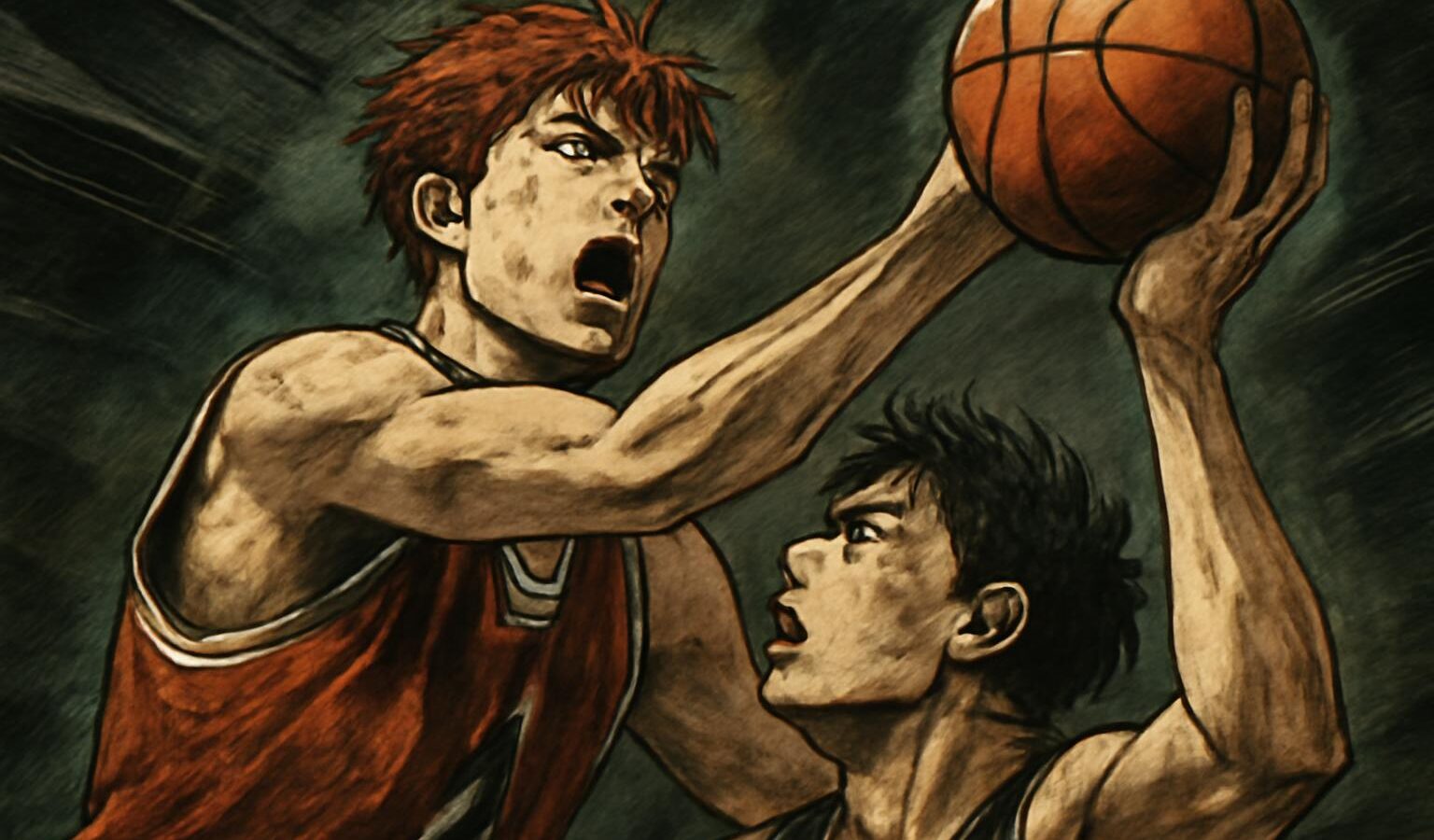
Inoue is one of the best draftsmen the medium has ever produced, and Slam Dunk is where he first proved it. His figures move. A jump feels like a jump; a fast break carries real speed. He also nails the small human stuff — the sweat, the disbelief on a bench player’s face, the quiet after a loss. It is a masterclass in visual storytelling that later blossomed into the brushwork of Vagabond.
What is remarkable is how Inoue’s art improves across the run. The early volumes are looser and more cartoonish, leaning into the comedy; by the final arcs, his linework has tightened into something photographic, capable of freezing a single decisive moment — a released shot, a held breath — with total clarity. He also understands the geography of a basketball court better than almost any artist who has drawn the sport, so you always know where every player is and why a play matters. That spatial clarity is a huge part of why the games read as genuinely thrilling rather than as a blur of speed lines.
Its cultural impact
Slam Dunk did not just entertain; it changed things. The series is widely credited with driving a surge of interest in basketball among Japanese teenagers in the 1990s, and its influence on the sports-manga genre is impossible to overstate — you can trace a direct line from Shohoku’s underdog run to countless series that followed. Decades after it ended, it still tops reader polls of the greatest manga of all time, and the acclaim only grew with the 2022 film The First Slam Dunk, which Inoue wrote and directed himself. Few completed series have aged so gracefully or held their reputation so firmly.
The characters
- Hanamichi Sakuragi — the brash, hilarious, self-proclaimed genius at the story’s heart.
- Kaede Rukawa — the cool, gifted rookie and Sakuragi’s rival.
- Takenori Akagi — the fierce team captain, “Gori.”
- Ryota Miyagi — the small, lightning-fast point guard.
- Hisashi Mitsui — the reformed delinquent with a deadly three-point shot.
Each Shohoku player gets a real arc, and the rival schools are drawn with equal care, so every opponent feels like a person rather than an obstacle.
Why it is still the benchmark
Plenty of sports manga are excellent, but Slam Dunk combines every strength at once: comedy, character, art, and genuinely tense competition, all wrapped in a complete story that ends at exactly the right moment. It never overstays its welcome, and its influence runs through nearly every sports manga that followed. For a full field of contenders, see our guide to the best sports manga.
The ending deserves special mention, because it is one of the boldest choices in the genre. Rather than dragging the team through years of tournaments, Inoue ends the series on a high, leaving certain threads deliberately open. Some readers wished for more; most came to see it as the perfect note to go out on — a reminder that these are teenagers whose lives extend beyond the court. That restraint is a big reason the book has never felt padded or diluted the way many long-running shonen eventually do.
Pros and cons
Pros
- One of the funniest and most exciting sports manga ever made
- A complete, satisfying story in 31 volumes
- Inoue’s dynamic art makes the games thrilling
- Sakuragi is an all-time great protagonist
Cons
- Ends before some readers want it to (no sequel arcs)
- Early volumes lean heavily on comedy before the drama deepens
- Long series — a real time commitment
How it compares to other sports manga
If you are weighing your options, here is how Slam Dunk stacks up against the sports titles readers most often ask about.
| Series | Sport | Length | Status | Best for |
|---|---|---|---|---|
| Slam Dunk | Basketball | 31 vols | Complete | Everyone |
| Haikyu!! | Volleyball | 45 vols | Complete | Ensemble fans |
| Ping Pong | Table tennis | 5 vols | Complete | Short and artful |
| Real (by Inoue) | Wheelchair basketball | Ongoing | On hiatus | Mature drama |
It also sits comfortably on our list of the best completed manga, since it is one of the rare all-time greats you can read start to finish.
Which edition should you buy?
The story is complete, so buying the full run is the goal — but you can dip a toe in first.
| Edition | Collects | Approx. price | Best for |
|---|---|---|---|
| Volume 1 paperback | 1 volume | ~US$10 | Trying it out |
| Single volumes | 1 each (31 total) | ~US$10 each | Building the set |
| Used complete sets | All 31 volumes | Varies | Best value binge |
The verdict
Slam Dunk lives up to every bit of its reputation. It is funny, thrilling, beautifully drawn, and — unlike Inoue’s later epic — it is finished, with an ending that fans have treasured for decades. Whether or not you care about basketball, this is essential reading and a cornerstone of any list of the best shonen manga. Start it and you will understand why it is still the one every other sports manga is measured against. Explore more in the manga hub.
Frequently asked questions
Is Slam Dunk finished?
Yes. The manga is complete in 31 volumes with a satisfying conclusion, which is a big part of why it is so widely recommended.
Do I need to like basketball to enjoy Slam Dunk?
No. The comedy and characters carry it even if you have never watched a game — though you may finish it a basketball fan.
Is Slam Dunk by the same author as Vagabond?
Yes, both are by Takehiko Inoue. See our Vagabond review for his acclaimed but unfinished samurai epic.
Should I watch The First Slam Dunk film first?
Either order works. The 2022 film adapts the climactic Sannoh match beautifully, but the manga gives you the full journey there.