Best Nonfiction & Memoir Graphic Novels
The best true stories told in comics — memoir, history and journalism.
 By Web Admin

The best nonfiction graphic novels do something prose struggles to match: they put you inside a memory. A cartoonist can draw herself as a child and as the adult narrating in the same panel, or hold a single image of a checkpoint, a hospital bed or an internment camp barracks long enough for it to sink in. Comics memoir, history and journalism have won a Pulitzer, a National Book Award and a shelf of literary prizes, and they sit on school and university syllabi everywhere. Every pick below is genuine nonfiction (lived experience, reported history or documented testimony) told in comics form, and every one is in print today.
As an Amazon Associate we earn from qualifying purchases.
How we chose: we started from the current Amazon listings for each book and weighed them against our own reading. We favored publisher editions you can buy now, complete editions over split volumes where they exist, and a spread of subjects so the list isn’t eight variations on one story. Prices and stock change often, so the buttons show Amazon’s current price.
| Pick | Best for | Why | Price | Buy |
|---|---|---|---|---|
| They Called Us Enemy | Best overall |
| $9.99as of Nov 23, 2026 11:33 pm UTC | View on Amazon |
| The Complete Maus | The essential classic |
| $19.30as of Nov 23, 2026 4:21 am UTC | View on Amazon |
| March (Omnibus Edition) | Civil rights history |
| $20.67as of Nov 23, 2026 3:32 pm UTC | View on Amazon |
| Fun Home | Literary memoir |
| $14.14as of Nov 23, 2026 10:23 am UTC | View on Amazon |
| Palestine | Comics journalism |
| $27.70as of Nov 23, 2026 11:33 pm UTC | View on Amazon |
| The Best We Could Do | Refugee family memoir |
| $11.48as of Nov 23, 2026 11:40 pm UTC | View on Amazon |
| Can't We Talk About Something More Pleasant? | Caring for aging parents |
| $10.82as of Nov 23, 2026 5:09 pm UTC | View on Amazon |
| Stitches | Short, stark childhood memoir |
| $11.30as of Nov 23, 2026 11:40 pm UTC | View on Amazon |
Prices and availability change; check Amazon for today’s price. As an Amazon Associate we earn from qualifying purchases.
1. They Called Us Enemy — Best overall

George Takei's childhood in America's WWII internment camps, told with warmth and clarity.
Check price on Amazon$9.99as of Nov 23, 2026 11:33 pm UTCWhy we like it
- A child's-eye view of a shameful chapter
- Clear enough for teens, rich enough for adults
- Harmony Becker's art is clean and expressive
- Connects the past to present-day debates without lecturing
| Specification | Details |
|---|---|
| Writers / Artist | George Takei, Justin Eisinger, Steven Scott / Harmony Becker |
| Publisher | IDW (Top Shelf) |
| Collects | Original graphic novel |
| Pages | 208 |
| Format | Paperback |
| Reader age / content | Not stated in listing; widely taught to middle and high schoolers |
They Called Us Enemy — Takei, Eisinger, Scott and Becker, IDW, 208 pages, paperback
Before he was Sulu on Star Trek, George Takei was a small boy whose family was forced from their Los Angeles home after Pearl Harbor and held in camps for Japanese Americans, first in Arkansas and then at Tule Lake in California. They Called Us Enemy tells that story from two vantage points at once: the child who thought some of it was an adventure, and the adult who slowly understood what his parents had endured and why his father still believed in American democracy anyway.
It's our top pick because it does what the best nonfiction comics do with the least friction. Harmony Becker's black-and-white art is uncluttered and quietly emotional, the chapters are short, and the history (Executive Order 9066, the "loyalty questionnaire," the renunciation of citizenship) is explained without ever stopping the story. It won an Eisner Award and has become a fixture in classrooms.
If you're buying one book for a reader who has never tried a graphic memoir, or for a family to share across ages, start here. Readers who want the heaviest canon work should go to Maus next.
Pros
- Accessible to readers from about 12 up
- History explained inside the story
- Moving father-son thread
Cons
- Less formally ambitious than Maus or Fun Home
- Adult framing sections can feel speech-like
- Readers wanting depth may need a prose follow-up
Get They Called Us Enemy on Amazon
2. The Complete Maus — Best essential classic

Spiegelman's Holocaust testimony and father-son portrait, both volumes in one hardcover.
Check price on Amazon$19.30as of Nov 23, 2026 4:21 am UTCWhy we like it
- The benchmark every nonfiction comic is measured against
- Both volumes in a single binding
- Survival story and family portrait in one
- Honest about the cost of telling the story
| Specification | Details |
|---|---|
| Creator | Art Spiegelman |
| Publisher | Pantheon |
| Collects | Maus I and Maus II |
| Pages | 296 |
| Format | Hardcover |
| Reader age / content | Not stated in listing; Holocaust violence, suicide, older teens and up |
The Complete Maus — Spiegelman, Pantheon, Maus I and II, 296 pages, hardcover
Art Spiegelman's account of his father Vladek's survival of Auschwitz, with Jews drawn as mice and Germans as cats, received a special Pulitzer Prize in 1992. It is two stories braided together: Vladek's wartime testimony, and the strained, often funny, often painful relationship between a son trying to record that history and a father who is difficult to love.
The animal metaphor sounds like a gimmick and turns out to be the opposite. It gives Spiegelman a way to show the machinery of dehumanization while keeping the people at the center. The second volume, which deals with the camps directly and with the success of the first book, is even more unsparing about what it means to turn a parent's trauma into art.
It ranks second here only because it is a harder first read than Takei's book. If you read one canonical nonfiction comic, it should be this. Our Maus review goes deeper.
Pros
- Complete story in one book
- Formally inventive and endlessly discussed
- Durable hardcover for a lifetime shelf
Cons
- Harrowing subject matter
- Hardcover costs more than the paperback box set
- Dense pages reward slow reading
Get The Complete Maus on Amazon
3. March (Omnibus Edition) — Best civil rights history

John Lewis's first-hand account of the civil rights movement, all three books in one volume.
Check price on Amazon$20.67as of Nov 23, 2026 3:32 pm UTCWhy we like it
- History told by someone who lived it
- All three books in one paperback
- Nate Powell's art makes crowds and violence immediate
- A classroom staple for good reason
| Specification | Details |
|---|---|
| Writers / Artist | John Lewis, Andrew Aydin / Nate Powell |
| Publisher | Top Shelf Productions |
| Collects | March: Book One, Two and Three |
| Pages | 588 |
| Format | Paperback omnibus |
| Reader age / content | Not stated in listing; racist violence and slurs, teens and up |
March (Omnibus Edition) — Lewis, Aydin and Powell, Top Shelf, complete trilogy, 588 pages
The late Congressman John Lewis co-wrote March with his aide Andrew Aydin, and it follows his path from a sharecropping family in Alabama through the Nashville lunch-counter sit-ins, the Freedom Rides and the march from Selma to Montgomery. The framing device, Lewis on the morning of Barack Obama's 2009 inauguration, gives the whole trilogy its sense of a long arc bending.
Nate Powell draws it in urgent black and white, and he is especially good at crowds, at the chaos of a beating and at the quiet discipline of nonviolent training. March: Book Three won the National Book Award for Young People's Literature, a first for a graphic novel.
The trilogy is also sold as a three-book slipcase set; the omnibus is the simpler buy if you want one spine and the whole story. See our March review for more.
Pros
- Complete trilogy in one book
- First-person authority
- Excellent for students and book groups
Cons
- Heavy for reading in bed
- Inauguration framing can feel sentimental
- Violence is graphic for younger readers
Get March (Omnibus Edition) on Amazon
4. Fun Home — Best literary memoir

Bechdel's dense, allusive family tragicomic about her closeted father and her own coming out.
Check price on Amazon$14.14as of Nov 23, 2026 10:23 am UTCWhy we like it
- Precise, layered writing that rewards rereading
- Bechdel's drawings carry as much as her captions
- Joyce, Proust and Fitzgerald woven into family history
- Funny as well as devastating
| Specification | Details |
|---|---|
| Creator | Alison Bechdel |
| Publisher | Mariner |
| Collects | Original graphic memoir |
| Pages | 240 |
| Format | Paperback |
| Reader age / content | Not stated in listing; sexuality, suicide, adults |
Fun Home — Bechdel, Mariner, 240 pages, paperback
Alison Bechdel grew up in a restored Victorian house in small-town Pennsylvania, with a father who taught English, ran the family funeral home (the "fun home") and hid his relationships with men. A few months after she came out to her parents in college, he was killed by a truck in what she believes was suicide. Fun Home circles that event from every angle, reading her father through the novels he loved and testing her own memories against diaries, letters and photographs.
It is the most literary book on this list, and the one that most rewards annotation. It was also adapted into a Tony-winning Broadway musical. Readers who like essayistic memoir in prose usually take to it immediately; readers who want straightforward narrative may find the looping structure slow.
Our full Fun Home review covers the book's craft in more detail.
Pros
- Exceptionally well written
- Rich enough for a book club
- Compact page count
Cons
- Non-linear structure demands attention
- Literary references can feel heavy
- Listing shows limited stock
5. Palestine — Best comics journalism

Joe Sacco's landmark reportage from the West Bank and Gaza in a new Fantagraphics hardcover.
Check price on Amazon$27.70as of Nov 23, 2026 11:33 pm UTCWhy we like it
- The book that defined comics journalism
- Sacco questions his own role as an outsider
- Testimony rendered with obsessive detail
- New hardcover adds an afterword by Amira Hass
| Specification | Details |
|---|---|
| Creator | Joe Sacco (introduction by Edward W. Said) |
| Publisher | Fantagraphics |
| Collects | The complete Palestine series |
| Pages | 300 |
| Format | Hardcover (2024 edition) |
| Reader age / content | Not stated in listing; violence, torture testimony, adults |
Palestine — Sacco, Fantagraphics, 2024 hardcover, 300 pages
In the early 1990s Joe Sacco spent two months in the West Bank and Gaza, interviewing people in refugee camps, hospitals and kitchens, and then drew what he heard. Palestine, first published as a comic series, is dense, self-implicating reportage: Sacco draws himself into almost every scene, wide-eyed and sometimes callow, and lets readers see how a journalist's presence shapes the story he collects. It won an American Book Award.
It is a demanding read, with caption-heavy pages and testimony that does not let up, and it is also the foundation for everything Sacco did after, including Safe Area Goražde and Footnotes in Gaza. Fantagraphics' 2024 hardcover keeps Edward Said's introduction and adds an afterword by Israeli journalist Amira Hass.
Pair it with our best political comics if you want more books that argue with the world.
Pros
- Unmatched as comics reportage
- Self-critical rather than preachy
- Handsome new hardcover
Cons
- Text-heavy and slow going
- Reporting reflects the early 1990s
- A cheaper Penguin paperback also exists
6. The Best We Could Do — Best refugee family memoir

Thi Bui traces her parents' lives through war in Vietnam and escape by boat to the US.
Check price on Amazon$11.48as of Nov 23, 2026 11:40 pm UTCWhy we like it
- Three generations of Vietnamese history in one family
- Ink-wash art in a warm rust palette
- Motherhood framing gives it emotional focus
- Explains a war Americans rarely see from this side
| Specification | Details |
|---|---|
| Creator | Thi Bui |
| Publisher | Abrams ComicArts |
| Collects | Original graphic memoir |
| Pages | 344 |
| Format | Paperback |
| Reader age / content | Not stated in listing; war violence, teens and up |
The Best We Could Do — Bui, Abrams ComicArts, 344 pages, paperback
Thi Bui begins with the birth of her own son and the sudden question of what she owes her parents. To answer it, she goes back through their lives: colonial Vietnam, the partition, the war, and the family's escape by boat in the late 1970s, followed by a new start in America. The result is a memoir about how trauma moves down a family line, and about the slow work of understanding parents as people.
Bui's ink-wash drawings in a single burnt-orange tone are beautiful and restrained. Where Maus centers one survivor's testimony, this book spreads its attention across a whole family, and it gives American readers a Vietnamese view of a war usually told from the other side.
It's the pick for readers who loved Persepolis and want another history-through-a-family memoir.
Pros
- Beautiful, distinctive art
- Teaches history without feeling like a lesson
- Strong book-club choice
Cons
- Timeline jumps can be hard to follow
- Quieter and slower than the top picks
- Ends on reflection rather than resolution
Get The Best We Could Do on Amazon
7. Can't We Talk About Something More Pleasant? — Best for anyone caring for aging parents
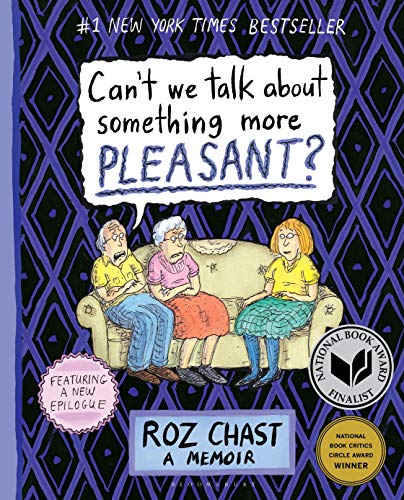
Roz Chast's funny, unsparing memoir of her parents' final years.
Check price on Amazon$10.82as of Nov 23, 2026 5:09 pm UTCWhy we like it
- Laugh-out-loud funny about a grim subject
- Mixes cartoons, photos and handwritten text
- Honest about guilt, money and exhaustion
- Instantly recognizable to anyone who has been there
| Specification | Details |
|---|---|
| Creator | Roz Chast |
| Publisher | Bloomsbury |
| Collects | Original graphic memoir |
| Pages | 240 |
| Format | Paperback |
| Reader age / content | Not stated in listing; illness and death, adults |
Can't We Talk About Something More Pleasant? — Chast, Bloomsbury, 240 pages, paperback
New Yorker cartoonist Roz Chast was an only child, and when her parents entered their nineties in their Brooklyn apartment, the job of managing their decline fell to her. This memoir covers the falls, the hoarded apartment, the assisted-living facility, the hospital visits and the conversations her parents refused to have, all in Chast's scratchy, anxious drawing style.
It won the National Book Critics Circle Award for autobiography and was a National Book Award finalist, but what readers remember is how funny and how honest it is. Chast doesn't pretend she was a saint, and that candor is exactly why people press this book on friends going through the same thing.
It's the most adult book here in the everyday sense: not graphic, but most meaningful to readers at a particular stage of life. Our comics about grief guide has more in this vein.
Pros
- Rare mix of humor and grief
- Practical and emotional honesty
- Quick, absorbing read
Cons
- Can hit hard for recent caregivers
- Chast's style is busy and hand-lettered
- Narrow subject compared with the history picks
Get Can't We Talk About Something More Pleasant? on Amazon
8. Stitches — Best short, stark childhood memoir

David Small's memoir of a silent, frightening childhood, told largely in pictures.
Check price on Amazon$11.30as of Nov 23, 2026 11:40 pm UTCWhy we like it
- Reads in an evening despite the page count
- Long wordless passages do the heavy lifting
- A chilling portrait of a cold family
- Ends on hard-won hope
| Specification | Details |
|---|---|
| Creator | David Small |
| Publisher | W. W. Norton & Company |
| Collects | Original graphic memoir |
| Pages | 336 |
| Format | Paperback |
| Reader age / content | Not stated in listing; emotional abuse, surgery, older teens and up |
Stitches — Small, W. W. Norton, 336 pages, paperback
Children's book illustrator David Small grew up in 1950s Detroit in a house where nobody said what they felt. At 14 he went in for what he was told was a minor operation on a growth in his neck and woke up with one vocal cord gone and barely able to speak. Nobody had told him it was cancer. Stitches is the story of that silence and of how he found his voice again, first through drawing and then through a therapist who finally told him the truth about his mother.
Small tells much of it in wordless sequences of gray wash, which makes the book move quickly and lets the dread build. It was a National Book Award finalist and is often taught alongside Persepolis and Fun Home.
For more books like it, see our best autobiographical comics.
Pros
- Fast and gripping
- Visual storytelling at its best
- Strong appeal to older teens
Cons
- Bleak family portrait
- Medical scenes may disturb some readers
- Less historical context than other picks
Why nonfiction works so well in comics
Comics are a memory medium. Panels sit on a page the way recollection sits in the mind: in fragments and juxtapositions rather than tidy paragraphs. A memoirist can draw herself at eight and at forty side by side, and a journalist can render a bombed street or a crowded interrogation room with a specificity that statistics never reach. That is why so many serious writers and artists have turned to the form, and why the best results outlast the news cycle that produced them.
Nonfiction comics fall into three broad camps, and knowing which one you want narrows the choice fast:
| Type | Picks above | Best for |
|---|---|---|
| Family and personal memoir | Fun Home, Stitches, Can't We Talk About Something More Pleasant? | Readers of literary memoir and essays |
| History through one life | They Called Us Enemy, Maus, March, The Best We Could Do | Students, teachers, history readers |
| Comics journalism | Palestine | Readers of long-form reporting |
How to choose a nonfiction graphic novel
- Match the reader's age. They Called Us Enemy and March suit readers from early teens; Fun Home, Palestine and Maus are better for older teens and adults.
- Buy the complete edition. Maus and March were originally split into separate books. The one-volume editions above save you hunting for the missing part.
- Start with a book that tells one story. If you're new to comics, a clear single narrative (Takei, Lewis, Small) is easier than a looping literary memoir like Fun Home.
- Use them as a doorway. Many readers who think comics "aren't for them" come in through memoir. Our best graphic novels list shows where these sit among the medium's best in every genre.
Also worth knowing: Marjane Satrapi's Persepolis (see our Persepolis review), Jarrett J. Krosoczka's Hey, Kiddo for younger readers, and Craig Thompson's Blankets, a long memoir of first love and religious upbringing.
Frequently asked questions
What is the best nonfiction graphic novel of all time?
Most critics would say Maus, which received a special Pulitzer Prize in 1992 and is still the standard for the genre. We put They Called Us Enemy first because it's the easiest place for a new reader to start, but Maus is the one to read eventually.
Are these appropriate for teenagers or classrooms?
Many are. March, They Called Us Enemy and Maus are widely taught, and Stitches works for older teens. Fun Home and Palestine deal with sexuality, suicide and violence and suit older teens and adults.
What counts as a graphic memoir?
A graphic memoir is autobiography told in comics form. Fun Home, Stitches and Roz Chast's book are classic examples. Comics journalism like Palestine is nonfiction too, but it reports on other people's lives rather than the author's own.
Do I need to like superhero comics to enjoy these?
Not at all. These books share almost nothing with capes and continuity. They are often the best titles to give a reader who thinks comics aren't for them.
Should I buy the hardcover or paperback?
For most of these, the standard paperback is the practical choice. The Maus and Palestine hardcovers above are worth it if you want a durable copy for a permanent shelf.
Is Maus a true story?
Maus is a true story: Art Spiegelman records his father Vladek's account of surviving the Holocaust, including Auschwitz, alongside their own strained relationship decades later. The animal heads, Jews as mice and Nazis as cats, are a metaphor, not fiction. Maus won a special Pulitzer Prize in 1992, and The Complete Maus collects both parts in one book, which is the edition to buy.
Should I read Maus or Persepolis first?
Read Persepolis first if you want an easier way in: Marjane Satrapi's memoir of growing up in Iran during the revolution has more humour and a lighter touch, and its bold, simple art is quick to read. Maus is heavier and slower, and it lands harder once you are used to reading comics. Both are classroom staples. Our Persepolis review covers which edition to get.
What is comics journalism?
Comics journalism is reporting told in comics form: the cartoonist travels, interviews people and draws what they find, often including themselves in the scene. Joe Sacco's Palestine, based on his time in the West Bank and Gaza in the early 1990s, is the book that defined the genre. The form lets a reporter show places, crowds and testimony at once, and it makes the reporter's own presence and bias visible.
How long does it take to read March?
The March omnibus runs to nearly 600 pages, so most readers take three or four evenings, roughly one per original book plus some extra time for the final volume. John Lewis's story moves quickly, but the scenes of violence and the speeches are worth slowing down for. If you are teaching it or reading with a teen, the three-book structure also makes natural stopping points.