The Best Middle-Grade Graphic Novels for Ages 8-12
Funny, heartfelt, adventurous books that turn 8-to-12-year-olds into lifelong readers.
 By Web Admin

Ask any school librarian which shelf empties fastest and the answer is the same everywhere: the graphic novels. For readers roughly 8 to 12, the format works wonders. The pictures carry hesitant readers over the hump, the humor keeps pages turning, and the best of these books carry real feelings about friendship, family and growing up. This guide to the best middle-grade graphic novels collects the books we’d hand a kid this weekend, from school stories and memoirs to fantasy, each with a reader-age note so you can match the book to the child.
As an Amazon Associate we earn from qualifying purchases.
How we chose: every pick had to pass three tests. Is it genuinely for this age, both emotionally and as an independent read? Will a kid actually finish it? Does it reward re-reading? We then checked each against the editions currently on Amazon. Prices and stock change often, so the buttons show Amazon’s current price.
| Pick | Best for | Why | Price | Buy |
|---|---|---|---|---|
| New Kid | Best overall |
| $7.54as of Nov 13, 2026 6:18 am UTC | View on Amazon |
| Smile | Best real-life school story |
| $7.00as of Nov 13, 2026 3:48 am UTC | View on Amazon |
| El Deafo | Best memoir |
| $8.79as of Nov 13, 2026 6:18 am UTC | View on Amazon |
| Roller Girl | Best for big friendship feelings |
| $7.47as of Nov 13, 2026 4:38 pm UTC | View on Amazon |
| When Stars Are Scattered | Best true story about the world |
| $7.51as of Nov 13, 2026 6:18 am UTC | View on Amazon |
| The Witch Boy | Best fantasy |
| $10.48as of Nov 13, 2026 6:18 am UTC | View on Amazon |
| Stargazing | Best friendship story |
| $7.04as of Nov 13, 2026 6:18 am UTC | View on Amazon |
Prices and availability change; check Amazon for today’s price. As an Amazon Associate we earn from qualifying purchases.
1. New Kid — Best middle-grade graphic novel overall
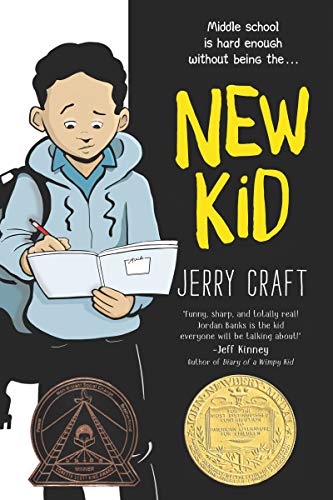
Jordan Banks starts seventh grade at a private school where he's one of very few kids of color.
Check price on Amazon$7.54as of Nov 13, 2026 6:18 am UTCWhy we like it
- Extremely funny and genuinely warm
- Sharp about everyday unfairness
- First graphic novel to win the Newbery
- Two sequels for kids who want more
| Specification | Details |
|---|---|
| Creator | Jerry Craft |
| Publisher | Quill Tree Books (HarperCollins) |
| Collects | The complete first book |
| Pages | 256 |
| Format | Paperback, full color |
| Reader age | Not stated in listing; 8–12 |
New Kid — Craft, Quill Tree Books, 256 pages
Seventh-grader Jordan Banks wants to go to art school. His parents send him to Riverdale Academy Day School instead, a prestigious private school where he's one of the few Black students and commutes from Washington Heights every day. Jerry Craft follows his first year: new friends, clueless teachers, classmates who mix him up with the other Black kid, and the strain of feeling like a different person at home and at school.
It's funny first, which is why kids love it, and razor-sharp about the small daily slights of not fitting in, which is why adults love it. Jordan's sketchbook pages, scattered through the book, add a second layer of commentary. In 2020 it became the first graphic novel to win the Newbery Medal, and it also won the Coretta Scott King Author Award.
The sequels, Class Act and School Trip, are just as good, and Quill Tree sells all three in a boxed set. It's the book we hand to almost every kid this age first.
Pros
- Works for readers and non-readers
- Great for family discussion
- Strong sequels
Cons
- Episodic, school-year structure
- Little action for adventure fans
- Some jokes aimed at adults
2. Smile — Best real-life school story

Raina Telgemeier's true story of knocking out her front teeth in sixth grade and the years of dental drama after.
Check price on Amazon$7.00as of Nov 13, 2026 3:48 am UTCWhy we like it
- Every kid recognizes the friendship politics
- Honest, funny and never preachy
- Clear art that reads quickly
- Opens a whole shelf of companion books
| Specification | Details |
|---|---|
| Creator | Raina Telgemeier |
| Publisher | Graphix (Scholastic) |
| Collects | The complete memoir |
| Pages | 224 |
| Format | Paperback, full color |
| Reader age | Not stated in listing; 8–12 |
Smile — Telgemeier, Graphix, memoir, 224 pages
In sixth grade, Raina trips and knocks out her two front teeth. What follows is years of braces, surgery, headgear and a fake-tooth retainer, tangled up with an earthquake, a first crush and a group of friends who aren't being very good friends. It's Raina Telgemeier's own story, and it's the book that built the modern middle-grade graphic novel.
Smile works because it takes small problems seriously. Nothing world-ending happens, but every kid who has felt embarrassed, left out or stuck with friends who tease them will see themselves. Readers who devour it should move on to Sisters and Guts, which Graphix sells together in a boxed set, then Drama and Ghosts.
If your reader loves Raina, the Baby-sitters Club graphic novels, which she started adapting, are the natural next step.
Pros
- Hugely relatable
- Easy entry for newer readers
- Plenty of companion books
Cons
- Dental scenes make some kids squirm
- Low stakes for adventure fans
- Many kids have already read it
3. El Deafo — Best memoir

Cece Bell's memoir of losing her hearing as a child, drawn with everyone as rabbits.
Check price on Amazon$8.79as of Nov 13, 2026 6:18 am UTCWhy we like it
- Funny and tender about disability
- Shows what hearing loss is actually like
- The superhero alter ego is irresistible
- Great read-aloud for families
| Specification | Details |
|---|---|
| Creator | Cece Bell |
| Publisher | Amulet Books (Abrams) |
| Collects | The complete memoir |
| Pages | 248 |
| Format | Paperback, full color |
| Reader age | Not stated in listing; 8–12 |
El Deafo — Bell, Amulet Books, memoir, 248 pages
At four, Cece Bell lost most of her hearing after meningitis. At school she has to wear a bulky hearing aid, the Phonic Ear, strapped to her chest, which makes her feel like a freak. Then she discovers it lets her hear her teacher anywhere in the building, including the bathroom, and she secretly becomes El Deafo, superhero.
The book is funny and specific about the small indignities of being different: friends who over-enunciate, a sleepover where she can't lip-read in the dark, the hunt for a true friend. Drawing everyone as rabbits keeps it light without softening anything. It was a Newbery Honor book, and Apple TV+ adapted it as an animated series.
It's especially good for kids who feel different for any reason, and it builds empathy in kids who don't.
Pros
- Unusual, eye-opening perspective
- Big laughs and real feeling
- Suits the younger end of the range
Cons
- Slow, episodic middle
- Set in the 1970s, some details dated
- Rabbit art may look young to 12-year-olds
4. Roller Girl — Best for big friendship feelings

Twelve-year-old Astrid discovers roller derby the same summer her best friend drifts away.
Check price on Amazon$7.47as of Nov 13, 2026 4:38 pm UTCWhy we like it
- Captures friendships changing at twelve
- Roller derby is a fresh, exciting setting
- A heroine who fails and keeps going
- Newbery Honor book
| Specification | Details |
|---|---|
| Creator | Victoria Jamieson |
| Publisher | Dial Books |
| Collects | The complete story |
| Pages | 256 |
| Format | Paperback, full color |
| Reader age | Not stated in listing; 9–12 |
Roller Girl — Jamieson, Dial Books, standalone, 256 pages
After her mom takes her to a roller derby bout, Astrid signs up for junior derby camp, assuming her best friend Nicole will join her. Nicole picks dance camp instead, with a girl Astrid can't stand. Astrid spends the summer falling on her face at practice, lying to her mom, and figuring out who she is without her best friend.
Victoria Jamieson, a roller derby skater herself, gets both the sport and the feelings right. It's honest that friendships end, and that you can behave badly while hurting. The derby scenes are thrilling, and Astrid's progress is earned rather than handed to her. It won a Newbery Honor.
Roller Girl suits slightly older middle-grade readers than El Deafo. Fans should try Jamieson's All's Faire in Middle School next.
Pros
- Emotionally honest
- Sporty, energetic setting
- Standalone
Cons
- Astrid makes frustrating choices
- Derby jargon takes a moment
- Less appeal for younger readers
5. When Stars Are Scattered — Best true story about the wider world

Omar Mohamed's childhood in a Kenyan refugee camp, caring for his younger brother and hoping to go to school.
Check price on Amazon$7.51as of Nov 13, 2026 6:18 am UTCWhy we like it
- A real refugee story told for kids
- Hopeful without hiding hardship
- Brotherly love at its core
- National Book Award finalist
| Specification | Details |
|---|---|
| Writer / Artist | Victoria Jamieson and Omar Mohamed / Victoria Jamieson (color by Iman Geddy) |
| Publisher | Dial Books |
| Collects | The complete story |
| Pages | 264 |
| Format | Paperback, full color |
| Reader age | Not stated in listing; 9–12; war, family separation |
When Stars Are Scattered — Jamieson and Mohamed, Dial Books, 264 pages
Omar and his younger brother Hassan fled the war in Somalia and spent their childhood in the Dadaab refugee camp in Kenya. Hassan is nonverbal and has seizures, and Omar is his caretaker. When Omar gets a chance to go to school, it means leaving Hassan for part of every day, and that choice drives the book.
Victoria Jamieson worked with Omar Mohamed to tell his true story, and it manages to be honest about hunger, boredom and loss while staying hopeful and age-appropriate. Kids who have never thought about what life in a camp is like come away with real understanding. It was a National Book Award finalist.
Content note: the brothers are separated from their mother by war, and her absence hangs over the book. It's moving rather than graphic. For more true stories, see our best nonfiction comics.
Pros
- Builds empathy and understanding
- Gripping despite quiet pace
- Great for classrooms
Cons
- Emotionally heavy in places
- Slower than adventure picks
- Younger kids may need context
Get When Stars Are Scattered on Amazon
6. The Witch Boy — Best fantasy

In Aster's family the girls become witches and the boys shapeshift. Aster wants to be a witch.
Check price on Amazon$10.48as of Nov 13, 2026 6:18 am UTCWhy we like it
- Cozy magic with real menace
- Thoughtful about being yourself
- Lovely, readable art
- Complete trilogy available
| Specification | Details |
|---|---|
| Creator | Molly Knox Ostertag (now credited as Lee Knox Ostertag) |
| Publisher | Graphix (Scholastic) |
| Collects | Book 1 of The Witch Boy trilogy |
| Pages | 224 |
| Format | Paperback, full color |
| Reader age | Not stated in listing; 8–12, mild fantasy peril |
The Witch Boy — Ostertag, Graphix, trilogy book 1, 224 pages
Thirteen-year-old Aster comes from a magical family with strict rules: girls learn witchcraft, boys learn to shapeshift. Aster is drawn to witchery, which is forbidden. When a dangerous creature starts taking the boys of the family, his secret knowledge may be the only thing that can help, and he finds an unexpected ally in Charlie, a girl from the non-magical town.
It's a gentle fantasy with a clear message about not letting other people decide who you are, delivered through a mystery and a satisfying confrontation rather than a lecture. Ostertag's art is soft and inviting. The story continues in The Hidden Witch and The Midwinter Witch.
It's the pick for kids who want magic instead of lockers and lunch tables. Kids who love it should look at Amulet and Bone in our best all-ages comics guide.
Pros
- Accessible fantasy
- Meaningful themes
- Trilogy is complete
Cons
- Short for a fantasy
- Villain is fairly simple
- Later volumes vary in stock
7. Stargazing — Best friendship story

Two very different Chinese American girls become best friends, until one of them gets sick.
Check price on Amazon$7.04as of Nov 13, 2026 6:18 am UTCWhy we like it
- Two complicated, likeable leads
- Honest about jealousy between friends
- Partly drawn from the author's life
- Standalone
| Specification | Details |
|---|---|
| Creator | Jen Wang |
| Publisher | First Second |
| Collects | The complete story |
| Pages | 224 |
| Format | Paperback, full color |
| Reader age | Not stated in listing; 9–12; serious illness |
Stargazing — Wang, First Second, standalone, 224 pages
Christine is the dutiful daughter who practices violin and follows the rules. Moon is the loud new girl who moves in next door, does K-pop dance routines and says she has visions of beings from the stars. They become best friends, then Christine grows jealous of Moon's popularity, and then Moon's visions turn out to be a symptom of something serious.
Jen Wang, who also wrote The Prince and the Dressmaker, based parts of it on her own childhood. It's good on how friendships survive envy and how different families show love. Content note: the illness subplot is handled gently but will upset some readers.
It's the natural pick for a kid who loved Smile and wants something with a little more plot.
Pros
- Emotionally rich
- Strong cultural detail
- Complete in one book
Cons
- Illness plot may upset some kids
- Christine's jealousy can frustrate
- Quieter than the fantasy picks
Picks at a glance
| Book | Best for | Pages | Age fit | More in the series? |
|---|---|---|---|---|
| New Kid | The all-rounder | 256 | 8–12 | Two sequels |
| Smile | Real-life school drama | 224 | 8–12 | Companions |
| El Deafo | Memoir, empathy | 248 | 8–12 | Standalone |
| Roller Girl | Friendship changes | 256 | 9–12 | Standalone |
| When Stars Are Scattered | True story, world issues | 264 | 9–12 | Standalone |
| The Witch Boy | Fantasy | 224 | 8–12 | Trilogy |
| Stargazing | Friendship, family | 224 | 9–12 | Standalone |
More middle-grade graphic novels by type of reader
- For quest-lovers: Kazu Kibuishi's Amulet, Jeff Smith's Bone (see our Bone review), Ben Hatke's Zita the Spacegirl and the Wings of Fire graphic novels.
- For kids who want to laugh: Dav Pilkey's Dog Man and Cat Kid Comic Club, John Patrick Green's InvestiGators and Judd Winick's Hilo. These lean toward the younger end.
- For friendship and feelings: Real Friends by Shannon Hale and LeUyen Pham, Kat Leyh's Snapdragon and Svetlana Chmakova's Awkward.
- For Raina fans: the Baby-sitters Club graphic novels, which Graphix also sells in boxed sets.
Print, digital and library tips
- Use the library first. These books are cheap to borrow and expensive to buy in bulk. Apps like Libby and Hoopla lend many of them digitally.
- Buy the ones they re-read. If a kid reads a book five times, that's the one worth owning.
- Series are a feature. A hooked reader will happily read a dozen more books. Let momentum work for you.
- Watch for boxed sets. Publishers bundle popular series (New Kid, Raina's memoirs) and discount them often, especially around back-to-school.
Younger readers should start with our best comics for kids, and older siblings can move on to the best graphic novels for teens. For the kid who still says reading is boring, our reluctant readers guide is built for that fight.
Frequently asked questions
What age are middle-grade graphic novels for?
Roughly 8 to 12, though strong younger readers and reluctant older readers both fit. The content is age-appropriate: real feelings and mild peril, nothing graphic.
Are graphic novels "real reading" for this age?
Yes. They build vocabulary, comprehension and visual literacy, and they're especially effective at turning reluctant readers into confident ones. The pictures support the text rather than replacing it.
Which one should I buy first?
New Kid for an all-rounder, Smile for a kid who likes real-life stories, or The Witch Boy for a fantasy fan. Match the pick to what the child already enjoys watching or playing.
Are these good to read as a family?
Very much so. New Kid, El Deafo and When Stars Are Scattered reward adult readers too, which makes them great for reading aloud or discussing together.
Which of these deal with heavy topics?
When Stars Are Scattered covers war and family separation, and Stargazing involves a serious illness. Both handle it gently, but it's worth knowing before you hand them to a sensitive reader.
What is the sequel to New Kid?
The sequel to New Kid is Class Act, followed by School Trip, both by Jerry Craft and both set at Riverdale Academy Day School. Class Act shifts focus to Jordan's friend Drew, while School Trip takes the group on a trip to Paris. They keep the humor and sharp observations about race and class from the first book, so kids who loved New Kid can carry straight on.
What should my child read after Smile?
After Smile, the easiest next read is more Raina Telgemeier: Sisters and Guts continue her real-life memoir stories, and Drama is a fictional school story about a theatre stage crew. If your child wants a change of author, try Roller Girl, El Deafo or Stargazing from this list, which share Smile's honest look at friendship and growing up.
What is El Deafo about?
El Deafo is Cece Bell's graphic memoir about losing her hearing as a young child and starting school with a powerful hearing aid strapped to her chest. She imagines the hearing aid gives her superpowers, becoming the hero "El Deafo," while she learns how to make friends. Every character is drawn as a rabbit, which keeps it light, funny and easy for younger readers to follow.
Is Dog Man a middle-grade graphic novel?
Dog Man is usually aimed at slightly younger readers than middle grade, roughly ages 7 to 10, with simpler text, slapstick humor and lots of jokes. Many 8 to 12-year-olds still love it, but it is closer to a chapter book in comics form than the books on this list. For younger readers or a broader range, see our best comics for kids by age guide.