Asterios Polyp Review: David Mazzucchelli’s Design Marvel
David Mazzucchelli's formally dazzling literary graphic novel.
 By Web Admin
Some graphic novels tell a story with pictures. A rare few make the pictures argue — where line, color, lettering and layout carry as much meaning as the dialogue. Asterios Polyp is the great modern example. Published in 2009 by Pantheon after roughly a decade of work, it was David Mazzucchelli’s first solo graphic novel, and it remains one of the most formally ambitious books the medium has produced.
It’s also a book people find intimidating, which is a shame, because underneath the design fireworks is a very human, often funny story about an arrogant man learning — too late, maybe — how to live. Here’s our full review.
What is Asterios Polyp?
Asterios Polyp is a self-contained, roughly 344-page hardcover graphic novel written, drawn, colored and designed by David Mazzucchelli. If that name rings a bell, it should: Mazzucchelli drew two of the most acclaimed superhero comics ever, Frank Miller’s Batman: Year One and Daredevil: Born Again, before walking away from mainstream comics to pursue more personal work. This book is the culmination of that turn, and it won multiple Eisner Awards on release.
The title character is a celebrated “paper architect” — a professor whose brilliant designs have won every award but have never actually been built. He is vain, controlling, and convinced the world can be sorted into neat dualities. As the book opens, his New York apartment is destroyed by fire, and he simply gets on a bus and rides it to the end of his money.
The story: an arrogant man starts over
Where the bus lets him off, Asterios talks his way into a job as a car mechanic and a room with the mechanic’s family, and begins — clumsily, unconsciously — to become a different person. Interwoven with this present-day thread are flashbacks to his marriage to Hana, a shy, gifted sculptor, and the slow, self-inflicted way he lost her. The narrator, it turns out, is Ignazio, Asterios’s twin brother, who died at birth — an absent double haunting a story obsessed with pairs.
It sounds heavy, and it has real weight, but it’s also wry and observant about academics, art-world pretension, and the small cruelties of a marriage. The emotional payoff sneaks up on you precisely because the surface is so playful.
The real subject: duality — and its limits
Asterios sees everything in twos: line and color, real and ideal, hedgehog and fox. Mazzucchelli’s masterstroke is to make the book’s form both express that worldview and quietly demolish it. Asterios thinks in binaries; the story keeps showing him that people and life are messier than any clean opposition. It’s a novel of ideas that never stops being a story about specific, flawed people.
The art: design as storytelling
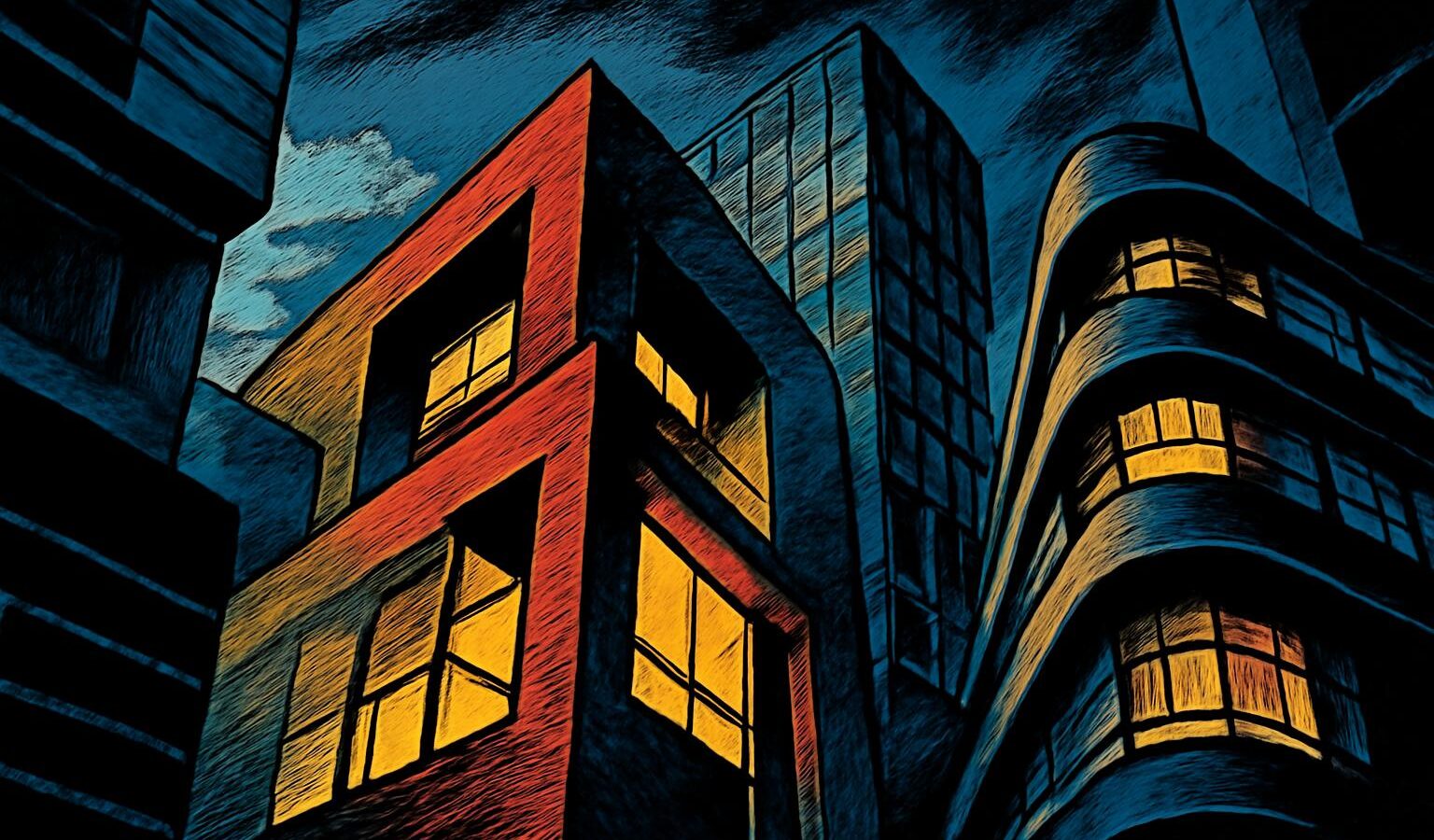
This is the reason the book is famous, and it’s worth spelling out. Mazzucchelli assigns visual languages to his characters. Asterios is often rendered in cool blue, purely linear geometry — all structure, no warmth. Hana is drawn in soft, warm, hatched reds and pinks — all texture, no hard edges. When they connect, their two styles literally merge on the page; when they drift apart, the drawing styles separate again. Even the lettering changes per character to reflect personality. The result is a book you can “read” through its color and line alone. It is, quite simply, one of the most intelligent uses of the comics form in print.
A word on difficulty
Let’s set expectations. Asterios Polyp is a literary graphic novel, not a page-turner, and it asks you to pay attention — to notice the color coding, the shifting styles, the way a panel’s shape carries meaning. It rewards a slow first read and reveals even more on a second. There’s no graphic content to warn about; the challenge here is purely one of attention and patience. Give it that, and few books repay it so fully.
Pros and cons
Pros
- A genuine masterpiece of comics form and design
- Completely self-contained — one beautiful volume
- Funny and human, not just clever
- Rewards re-reading like almost nothing else
Cons
- Demanding; not a casual read
- The “unlikeable professor” lead won’t click for everyone
- Best appreciated in the physical hardcover
How it compares to other literary graphic novels
If you’re exploring comics as literature, here’s where Asterios Polyp sits among the usual touchstones.
| Book | Creator | Best for | Approx. price |
|---|---|---|---|
| Asterios Polyp | David Mazzucchelli | Formal invention & design | ~US$30 |
| Maus | Art Spiegelman | Memoir & history | ~US$25 |
| Blankets | Craig Thompson | Coming-of-age emotion | ~US$30 |
| Fun Home | Alison Bechdel | Literary memoir | ~US$18 |
For the wider field, see our best graphic novels list and our roundup of the best indie graphic novels.
Which edition should you buy?
The good news is simple: it’s one book, and it was designed as an object.
| Edition | Format | Approx. price | Best for |
|---|---|---|---|
| Pantheon hardcover | Hardcover, ~344 pp | ~US$30 | The definitive way to read it |
| Paperback edition | Softcover | ~US$22–25 | Budget-conscious readers |
Because the color and paper are part of the storytelling, we’d steer you to the physical hardcover over digital if you can — this is a book that belongs among the best deluxe editions on a shelf.
AmazonCheck price on AmazonWhat to watch for on a first read
A few reading tips make the book click faster. Pay attention to color: when a scene collapses into a pure blue-and-red duotone, Asterios is retreating into his binary way of seeing the world, and the palette tells you so before the dialogue does. Watch the panel borders and the shapes of the word balloons, too — Mazzucchelli changes them to reflect who really holds a conversation. And notice the recurring motifs of trees, lightning, and pairs of things, which quietly organize the whole book. None of this is homework; it’s the pleasure of the thing. But knowing to look means the design speaks to you on the very first pass rather than the third, and it turns a single reading into two or three books in one.
Is it a good first graphic novel?
It can be, for the right reader. If you come from literary fiction and want proof that comics can be Serious Art, this is a spectacular gateway — and it’s short enough to finish in a couple of focused sittings, earning it a place among the best comics you can read in one sitting. If you’re brand new to comics generally and want something more propulsive first, start elsewhere and circle back. Either way it belongs near the top of any standalone graphic novels shortlist.
The verdict
Asterios Polyp is one of those rare books that expands your sense of what the medium can do. It’s intellectually dense but never cold, gorgeous but never merely decorative, and it repays every ounce of attention you give it. A permanent fixture in our Indie hub and an easy recommendation to anyone ready to read comics as literature.
Frequently asked questions
Is Asterios Polyp a standalone story?
Yes — it’s a single, complete, self-contained graphic novel with a definite ending. There are no sequels or prior reading required.
Is Asterios Polyp hard to read?
It’s demanding rather than difficult. The story is clear, but the visual design carries so much meaning that it rewards slow, attentive reading and, ideally, a second pass.
Who is David Mazzucchelli?
An acclaimed cartoonist who first drew Frank Miller’s Batman: Year One and Daredevil: Born Again, then moved to personal, literary work. Asterios Polyp is his first solo graphic novel.
Is there any mature content?
There’s some brief nudity and adult relationship themes, but nothing graphic. The real barrier to entry is its ambition, not its content.
Explore more creator-driven work in our best indie graphic novels guide or browse the whole Indie hub.