Cyborg Reading Order: Where to Start
From New Teen Titans to Justice League and his solo run.
 By Web Admin

Cyborg is one of DC’s great modern success stories — a character who started as a teenage team player and climbed all the way to founding member of the Justice League. Victor Stone is a former high-school athlete rebuilt with cybernetic technology after a horrific accident, and his best stories wrestle with a genuinely human question: how much of your body can be replaced before you stop feeling human at all?
This Cyborg reading order traces his journey from the classic New Teen Titans of the 1980s through his elevation to the Justice League in DC’s New 52 relaunch, and into his own solo series. Whether you know him from the animated Teen Titans, the DC films, or nowhere at all, this guide gives you a clear path into the comics.
The books to buy, in reading order
These are the collected editions that cover the path below, in the order to read them.
| Pick | Best for | Why | Price | Buy |
|---|---|---|---|---|
| New Teen Titans Omnibus Vol. 1 | Start here |
| $68.93as of Nov 5, 2026 12:07 pm UTC | View on Amazon |
| Justice League Vol. 1: Origin | Then: Justice League Origin |
| $16.95as of Nov 5, 2026 12:07 pm UTC | View on Amazon |
| Cyborg Vol. 1: Unplugged | Then: his solo series |
| $11.99as of Nov 5, 2026 12:07 pm UTC | View on Amazon |
| Cyborg Vol. 1: The Imitation of Life | Then: the Rebirth solo |
| $15.98as of Nov 5, 2026 12:07 pm UTC | View on Amazon |


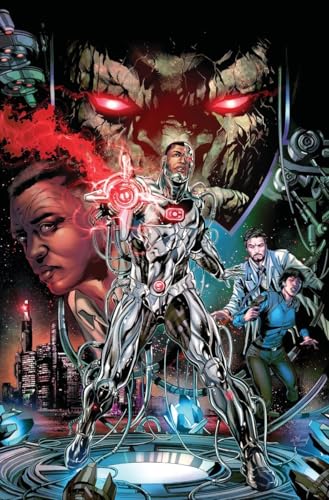
Prices and availability change; check Amazon for today’s price. As an Amazon Associate we earn from qualifying purchases.
Who is Cyborg?
Victor Stone was a gifted young athlete and the son of two S.T.A.R. Labs scientists. After an accident (in most versions, an experiment gone wrong) leaves him gravely injured, his father saves his life by grafting cutting-edge cybernetic technology onto his body. The result is Cyborg: super-strong, armored, and able to interface directly with computers and technology, but forever changed and often struggling to reconcile the man he was with the machine he has become. That tension — power at the cost of identity — is the emotional engine of every good Cyborg story.
Cyborg reading order at a glance
| Order | Story / collection | Creators | Era | Why it matters |
|---|---|---|---|---|
| 1 | The New Teen Titans | Wolfman & Pérez | 1980s | His origin and defining team |
| 2 | Justice League: Origin | Johns & Lee | 2011 | Cyborg becomes a founder |
| 3 | Cyborg (2015 solo) | David F. Walker | 2015–2018 | His first ongoing solo |
Start here: The New Teen Titans (1980s)
Cyborg was created by Marv Wolfman and George Pérez, debuting in a 1980 preview and then starring in The New Teen Titans, one of the most beloved super-team runs DC has ever published. Alongside Robin, Starfire, Raven, Beast Boy, and Kid Flash, Victor is a foundational member, and the run gives his origin real weight — the resentment toward his father, the fear of rejection, the slow discovery of a new family in the Titans. Wolfman and Pérez's storytelling is warm, character-first, and still holds up beautifully.
The most efficient way in is The New Teen Titans Omnibus volumes or the individual trade paperbacks. This run is also the heart of our Teen Titans reading order, which maps the whole team's history if you want to keep going.
The standout arc from this era is "The Judas Contract," a landmark storyline in which the team is betrayed from within. Cyborg is central to it, and it is widely regarded as one of the greatest team-comic stories of the 1980s — an all-time classic that shows Victor and the Titans at their best. If you only read one New Teen Titans collection, make it the one containing "The Judas Contract," then work outward from there. It also demonstrates why Wolfman and Pérez's Titans were, for a stretch, outselling nearly everything else DC published.
Justice League: Origin (2011) — Cyborg joins the big leagues
DC's 2011 "New 52" relaunch made a bold move: it promoted Cyborg from Titan to founding member of the Justice League. In Justice League Vol. 1: Origin by Geoff Johns and Jim Lee, Victor gains his powers during the League's first mission against Darkseid, standing shoulder-to-shoulder with Superman, Batman, and Wonder Woman from day one. It was a significant elevation for the character and remains a strong, blockbuster-scale entry point. The art by Jim Lee is a major draw in its own right.
If seeing him on the League hooks you, our Justice League reading order lays out where to go next, and our best DC graphic novels guide flags the essentials.
Cyborg (2015): his first solo ongoing
Victor finally headlined his own ongoing series in 2015, written by David F. Walker. The book leans into the science-fiction and identity questions at the character's core — what it means to be human when your body is technology, and how others perceive you. It is the best place to see Cyborg as a lead rather than a supporting player, and it gives his supporting cast and inner life room to breathe. A later volume continued the solo adventures during DC's Rebirth era.
Cyborg's powers and what makes him tick
Cyborg's abilities scale with the technology in his body, which is part of what makes him so useful on a team like the Justice League. He has superhuman strength and durability, built-in weaponry (his signature "sonic cannon" or white-noise blaster), flight in many versions, and — most importantly in modern stories — the ability to interface directly with computers, networks, and other technology. In the New 52, his body incorporates elements of alien Mother Box technology, which pushes his connectivity to a cosmic level and ties him directly to threats like Darkseid and the Anti-Life Equation. But the powers are never the point on their own. The best Cyborg writers use them to ask whether Victor is a man with machine parts or a machine that remembers being a man, and that question is what keeps him compelling issue after issue.
Do you need to read it all?
Not at all. Cyborg's essential reading is short and sweet: The New Teen Titans for his origin and defining relationships, and Justice League: Origin for his promotion to the big leagues. The 2015 Cyborg solo series is the natural next step if you want him as a headliner. Everything beyond that — his many appearances across DC crossovers and events — is optional bonus reading. Because his key stories are collected in accessible editions, you can get the full measure of the character from just two or three books.
Cyborg across the DC universe
Beyond these core books, Cyborg turns up throughout DC's crossovers and event comics as a key League member, and he remains a fixture in adaptations from the animated Teen Titans to the DC films. Those appearances are a bonus rather than required reading, but they show how central he has become. You can browse the wider DC library from the DC hub.

Wolfman and Pérez's New Teen Titans is the definitive Cyborg origin — his accident, his anger, and the found family…
Check price on Amazon$68.93as of Nov 5, 2026 12:07 pm UTCOur take: Wolfman and Pérez's New Teen Titans is the definitive Cyborg origin — his accident, his anger, and the found family that made him. It is also simply one of the best team comics DC ever published.
How to actually buy these
Cyborg's key stories are well collected, so you can build a strong run without hunting single issues:
- The origin: The New Teen Titans — omnibus for the deep dive, or trade paperbacks for a lighter start.
- The promotion: Justice League Vol. 1: Origin for his rise to the League, with gorgeous Jim Lee art.
- The solo: the 2015 Cyborg trades for Victor as a headliner.
Get New Teen Titans Omnibus Vol. 1 on Amazon
Frequently asked questions
Where should a beginner start with Cyborg?
Start with The New Teen Titans by Marv Wolfman and George Pérez. It contains his origin and his defining relationships. If you would rather begin with big-league superhero action, Justice League Vol. 1: Origin (2011) is a great modern jumping-on point.
Is Cyborg a founding member of the Justice League?
In DC's New 52 continuity (2011), yes — he became a founding member in Justice League: Origin by Geoff Johns and Jim Lee. In earlier continuity he was primarily a member of the Teen Titans.
Does Cyborg have his own comic series?
Yes. His first ongoing solo series launched in 2015, written by David F. Walker, with a further volume during the Rebirth era. Both focus on the identity and science-fiction themes at the heart of the character.
Do I need to read the Teen Titans before the Justice League stories?
No. The 2011 Justice League run re-tells his origin for new readers, so you can start there cold. That said, The New Teen Titans gives his character far more depth — see our Teen Titans reading order for the full path.